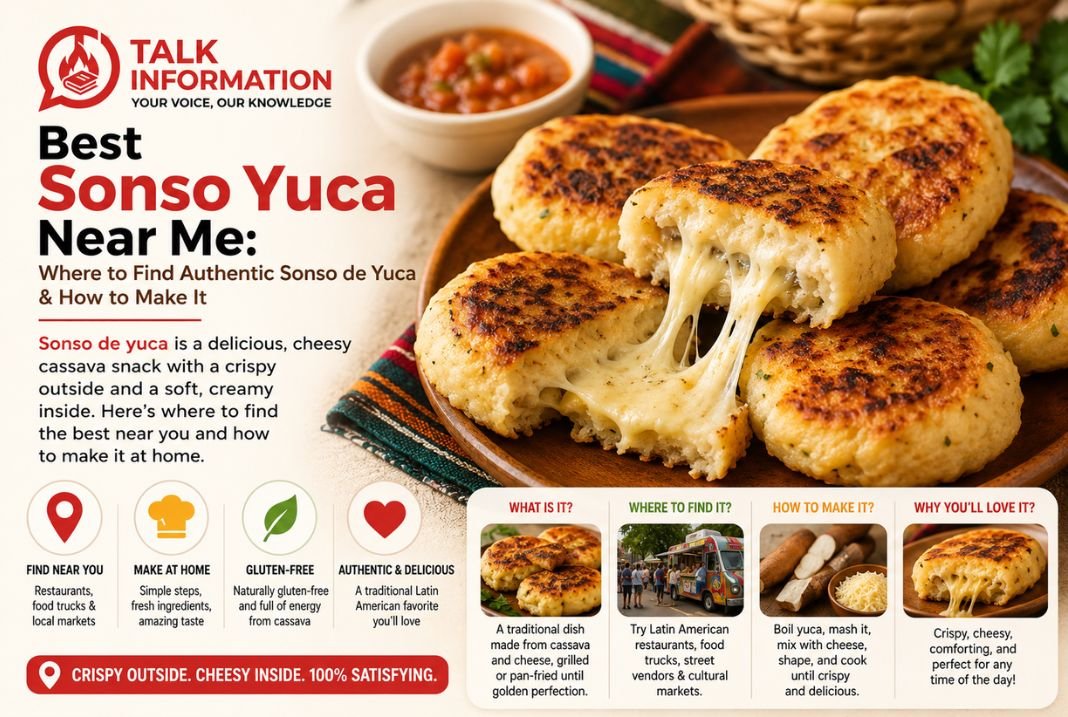

Sonso de yuca is one of those dishes that quietly wins over everyone who tries it. Whether you first tasted it at a Latin American street food stall or heard about it from a foodie friend, one thing is certain — once you have it, you want more. This guide covers everything from what sonso de yuca actually is, where to find the best sonso yuca near me searches lead, and how to make it perfectly at home.
What Is Sonso de Yuca? (Featured Snippet)
Sonso de yuca is a traditional snack and comfort food originating primarily from Bolivia and Colombia. At its simplest, it is a dough made from boiled and mashed cassava root, mixed with cheese — usually queso fresco — shaped into balls or logs, and then grilled, baked, or pan-fried until golden. The result is a crispy crust on the outside, a soft center on the inside, and an irresistible cheese pull that makes it impossible to eat just one.
Definition of Sonso de Yuca
Sonso de yuca translates roughly to “yuca dumpling” or “cassava cake” depending on the region. The word “sonso” in Bolivian cuisine refers to a type of mashed or worked cassava preparation — dense, cheesy, and deeply satisfying. It falls somewhere between a fritter and a bread, but honestly it deserves its own category entirely.
Why It Is Popular Across Latin America
Sonso de yuca has spread across Latin America because it checks every box: it is affordable, made from widely available ingredients like fresh cassava, it travels well as a portable snack, and it appeals to almost every palate. From Bolivia’s highland kitchens to Colombia’s bustling food markets, sonso yuca has become a beloved regional delicacy with serious cross-border fans.
Origin, History & Cultural Significance of Sonso de Yuca
Few dishes carry as much cultural heritage as sonso de yuca. It is more than food — it is a marker of identity, community, and tradition.
Traditional Roots
The roots of sonso de yuca go deep into Indigenous communities across South America, where cassava — also called manioc — was a dietary staple long before colonial contact. The dish is most strongly associated with Bolivia, particularly the eastern lowland regions, and with Colombia’s Valle del Cauca. It also appears in various forms across Amazonian cuisine and traces can be found in the Caribbean region and Peruvian cuisine, reflecting how widely cassava traveled across South American food traditions.
In rural kitchens and traditional households, sonso de yuca was a breakfast item, a side dish during community meals, and a go-to comfort food for family gatherings. It was handmade food at its purest — no fancy tools, just yuca, cheese, and fire.
How the Dish Is Prepared
Traditional preparation of sonso de yuca begins with fresh cassava. The cassava root is peeled, boiled until tender, then mashed by hand or with a wooden pestle. Queso fresco or a similar quality cheese is worked into the warm mash until a smooth, pliable dough forms. The dough is then shaped and cooked — traditionally grilled over an open flame, though pan-fried and baked versions are equally common. Traditional cooking techniques passed down through generations make a real difference in the final texture and taste.
What Does Sonso de Yuca Taste Like?
If you have never tried sonso de yuca, describing the flavor is almost as fun as eating it.
Flavor Profile
The flavor is mild, savory, and deeply comforting. Fresh cassava has a subtle earthiness that pairs beautifully with the salty tang of queso fresco or melted cheese. When grilled or pan-fried, the outside develops a golden crust with a slightly smoky, buttery flavor. It is a savory snack that does not overwhelm — it is the kind of thing you eat slowly and appreciate with every bite.
Texture and Key Ingredients
The texture is where sonso de yuca really shines. You get a crispy texture on the outside and a creamy interior that is soft and cheesy at the same time. The cheese pull when you break it open is genuinely satisfying. The key ingredients are simple: fresh cassava (the root vegetable that anchors everything), quality cheese, salt, and sometimes a small amount of butter or egg depending on the regional recipe. That simplicity is part of the charm.
How to Find the Best Sonso Yuca Near You
Searching for the best sonso yuca near me can feel a little overwhelming if you do not know where to look. Here is a breakdown of where to start.
Local Latin American Restaurants
Your first and best bet is local Latin American restaurants, especially those focused on Bolivian or Colombian cuisine. Specialty Bolivian restaurants and family-owned restaurants are most likely to offer authentic sonso yuca on their menu. Look for spots that pride themselves on regional food and authentic culinary tradition — those are the places where sonso de yuca is made with care, not as an afterthought.
Use Google Maps and Yelp to search for “Latin American restaurant near me” or “Bolivian food near me.” Read through customer reviews and look for mentions of sonso de yuca specifically. Highly rated dishes in online reviews often give you a shortlist of the best options in your city.
Food Trucks & Street Vendors
Latin American street food culture is thriving in many cities. Street vendors, food trucks, and street stalls at cultural markets or weekend markets are excellent sources of freshly made sonso de yuca. Hispanic vendors and South American vendors who specialize in traditional snacks often serve sonso yuca as part of a broader street food menu.
Check your local food festivals, especially those celebrating Latin culture, where traditional vendors bring authentic flavors directly to the community. These are often hidden gems that food bloggers discover before anyone else.
Grocery Stores and Online Review Platforms
Some Latin grocery stores and specialty food markets stock frozen or freshly prepared sonso de yuca, particularly in cities with significant Latin American communities. Ask store staff directly — they often know of local vendors or homemade food sellers in the area.
For online research, platforms like Yelp and Google Maps are your best tools. Filter by cuisine type and use local search intent keywords to narrow results. Food delivery apps like DoorDash or Uber Eats sometimes list cafés and restaurants offering sonso de yuca, especially in areas with high South American food demand.
Tips for Finding Authentic Sonso de Yuca
| Tip | Why It Matters |
| Look for made to order places | Fresh batches mean better texture and taste |
| Check for queso fresco on the menu | Authentic recipe uses the right cheese |
| Ask if yuca is fresh or frozen | Fresh cassava makes a noticeable difference |
| Read online reviews carefully | Other food enthusiasts flag authentic preparation |
| Visit on weekends | Many local vendors only operate on weekends |
What Makes a Great Sonso de Yuca?
Not all sonso de yuca is created equal. Here is what separates a great one from a forgettable one.
Fresh Ingredients
The quality of sonso de yuca starts with fresh cassava. Fresh cassava root mashes more smoothly, holds together better, and tastes cleaner than frozen alternatives. Similarly, using premium ingredients for the cheese — a proper queso fresco or a good cheese blend — makes a real difference. Handcrafted food made with fresh preparation and traditional ingredients always shows in the final product.
Authentic Preparation Methods
Authentic preparation follows the traditional recipe closely. The cassava is cooked properly (not undercooked, which leaves a gummy texture, and not overcooked, which makes it fall apart). The cheese is folded in while the mash is still warm so it melts and integrates fully. The shaping and cooking method — whether grilled, pan-fried, or baked — is done with attention to time and heat. Artisanal cooking and traditional methods separate a truly great sonso de yuca from a rushed version.
Crispy Texture and Cheese Quality
The gold standard for sonso de yuca is a crispy crust that gives way to a soft center packed with cheesy filling. The cheese pull should be generous and the interior creamy, never dry. Quality cheese matters enormously here — low-quality cheese does not melt properly, which ruins the cheesy filling and the overall dining authenticity of the experience.
How to Make Sonso de Yuca at Home
Making homemade sonso yuca is one of the most rewarding culinary experiences you can have in your kitchen. The recipe is straightforward and the result is spectacular.
Ingredients Needed
| Ingredient | Amount |
| Fresh cassava (yuca) | 500g, peeled and chopped |
| Queso fresco (or mozzarella) | 200g, crumbled or grated |
| Salt | 1 tsp (adjust to taste) |
| Butter (optional) | 1 tbsp |
| Egg (optional, for binding) | 1 large |
| Oil or butter for cooking | As needed |
These traditional ingredients are all you need for an authentic recipe that delivers real, authentic flavors at home.
Step-by-Step Instructions
Step 1 — Boil the Yuca Peel the fresh cassava and cut into large chunks. Place in a pot, cover with salted water, and boil for 20–25 minutes until completely tender and easy to pierce with a fork.
Step 2 — Drain and Mash Drain the cooked cassava root thoroughly and remove any fibrous strings from the center. Mash while still hot using a fork, potato masher, or wooden pestle. Mash until smooth with no large lumps.
Step 3 — Add the Cheese While the mash is still warm, add your queso fresco (or cheese blend) and salt. If using butter or egg, add them here as well. Mix and knead until the cheese is fully incorporated and a smooth, workable dough forms. The warmth of the yuca will help the melted cheese integrate beautifully.
Step 4 — Shape the Sonso Take portions of dough (about the size of a golf ball or slightly larger) and roll them into balls, oval logs, or flat patties depending on your preference. Traditional preparation in Bolivia often uses a cylindrical shape.
Step 5 — Cook
- Grilled: Place on a hot greased grill or griddle for 4–5 minutes per side until a golden crust forms.
- Pan-fried: Heat oil in a pan over medium heat and cook each piece for 3–4 minutes per side until the crispy crust develops.
- Baked: Place on a lined baking sheet, brush with oil or butter, and bake at 200°C (390°F) for 20–25 minutes, flipping halfway.
Step 6 — Serve Hot Sonso de yuca is best served fresh and hot — the crispy texture and cheese pull are at their peak right off the heat. Serve as a savory treat for breakfast, as a side dish, or as a standalone comfort meal.
Pro Tips for the Perfect Crispy Texture
- Always mash yuca while it is hot — cold cassava becomes stiff and hard to work with.
- Do not skip the kneading step — working the dough gives it the right consistency for a soft center and crispy crust.
- For the best golden crust when pan-frying, press the dough pieces gently with a spatula and avoid moving them too much.
- If the dough is too sticky, add a small amount of cassava flour or extra cheese to firm it up.
- For a gourmet adaptation, try adding herbs like cilantro or a pinch of smoked paprika to the dough for a modern twist.
- Baked cassava versions are slightly lighter in calories; grilled cassava gives the best smokiness.
Health Benefits of Sonso de Yuca
Beyond its taste, sonso de yuca has some genuine health perks worth knowing about.
Gluten-Free Benefits
One of the most appreciated qualities of sonso de yuca among food enthusiasts today is that it is completely gluten-free. Cassava root contains no gluten naturally, making sonso de yuca a safe and satisfying option for those with celiac disease or gluten sensitivity. As a gluten-free comfort food, it fits easily into modern dietary needs without sacrificing any of the traditional flavors.
Nutritional Value
Cassava is a good source of carbohydrates, providing sustained energy — which is why it was such an essential food for Indigenous communities doing physical work. It also contains some fiber, vitamin C, and B vitamins. When paired with queso fresco, sonso de yuca adds protein and calcium to the meal. As a root vegetable, cassava is one of the more nutritionally versatile bases in South American food traditions.
Energy and Digestive Benefits
The complex carbohydrates in cassava release energy steadily, making sonso de yuca an excellent breakfast or side dish for sustained energy throughout the day. Cassava also contains resistant starch, which acts as a prebiotic and supports digestive health. For those looking for a comfort meal that also supports the gut, sonso de yuca is a smart choice.
Popular Variations of Sonso de Yuca
Sonso de yuca has inspired a wonderful range of variations across regions and kitchens.
Traditional Version
The traditional version sticks closely to the authentic recipe: fresh cassava, queso fresco, salt, and simple cooking. In Bolivia, particularly around the eastern lowlands, this classic snack is made exactly as it has been for generations — grilled over charcoal or pan-fried in a cast iron pan. This version prioritizes cultural authenticity above all else and is still the most widely made in traditional households.
Cheese-Filled Variations
Some cooks take the cheesy filling concept further by stuffing the sonso de yuca with an additional layer of melted cheese inside the dough ball before cooking. This creates an extra cheese pull and a richer, more indulgent interior. In Colombia, particularly in Valle del Cauca, cheese-filled variations are very popular at local eateries and food markets, often featuring a cheese blend for maximum melt.
Modern Restaurant Styles
Urban restaurants and fusion Latin cuisine chefs have taken sonso de yuca and run with it. Gourmet adaptation versions feature truffle oil, smoked cheeses, herb-infused doughs, and creative dipping sauces. Some upscale cafés serve baked cassava sonso as a gluten-free side dish paired with soups or salads. These modern takes celebrate culinary creativity while keeping the soul of the dish intact. Whether you call it artisanal cooking or just inspired cooking, these versions bring sonso de yuca into contemporary dining authenticity.
Pros and Cons of Sonso de Yuca
| Pros | Cons |
| Naturally gluten-free | Can be high in carbohydrates |
| Made from simple, affordable ingredients | Fresh cassava can be hard to find in some areas |
| Versatile — grilled, baked, or pan-fried | Requires eating fresh for best crispy texture |
| Delicious as a breakfast, snack, or side dish | Can dry out quickly if not stored properly |
| Deep cultural heritage and authentic flavors | Less familiar in non-Latin communities |
| Easily customizable with different cheeses | Frozen yuca produces a less authentic texture |
| Great for family gatherings and community meals | High cheese content means higher fat and calories |
Frequently Asked Questions
What does “Sonso” mean in Bolivian cuisine?
In Bolivian cuisine, “sonso” refers to a mashed or worked preparation of cassava that is shaped and cooked, typically with cheese mixed in.
Can I use frozen yuca to make Sonso de Yuca?
Yes, frozen yuca works in a pinch, but fresh cassava gives a smoother mash, better texture, and more authentic flavor.
How do I reheat leftover Sonso de Yuca?
Reheat in a pan over medium heat or in the oven at 180°C to restore the crispy crust — avoid the microwave as it softens the exterior.
Is Sonso de Yuca gluten-free?
Yes, sonso de yuca is naturally gluten-free since cassava root contains no gluten, making it safe for those with gluten sensitivity.
What cheese is best for Sonso de Yuca?
Queso fresco is the traditional choice, but mozzarella, quesillo, or any good melting cheese also works beautifully in this recipe.
Where can I buy Sonso de Yuca near me?
Check specialty Bolivian restaurants, family-owned Latin American restaurants, food festivals, weekend markets, and food delivery apps in your area.
How long does it take to make Sonso de Yuca at home?
The whole process takes about 45 minutes to an hour, including boiling the cassava, making the dough, and cooking until golden.
Can Sonso de Yuca be baked instead of fried?
Absolutely — baked cassava sonso is a lighter option and still develops a nice golden crust when brushed with oil and baked at high heat.
Final Thoughts
Sonso de yuca is the kind of dish that represents the very best of Latin American street food — humble ingredients, masterful technique, and layers of cultural heritage baked (or grilled) into every bite. Whether you are a seasoned food explorer on a culinary journey or someone who just discovered it through a local search, sonso de yuca deserves a permanent spot in your food life.
Finding the best sonso yuca near me might take a little searching — a scroll through Yelp, a walk through a cultural market, or a visit to a family-owned restaurant — but the reward is absolutely worth it. And if you cannot find it nearby, making homemade sonso yuca from this guide will bring the authentic culinary tradition straight to your kitchen.
So go ahead — mash the cassava, fold in the cheese, and get cooking. Your new favorite comfort food is waiting.
You Might Also Like:
- Babeltee – The Modern Tea Culture, Wellness Drink & Lifestyle Trend Guide
- Rhonda Worthey: Bio & Life After Troy Aikman
- Is Peter Orszag Bald? Truth Behind the Viral Hair Rumors & Public Curiosity

Welcome to our site. I am admin of TalkInformation.com, an AI-Powered SEO, And Content Writer with 4 years of experience. I help websites rank higher, grow traffic, and look amazing, my goal is to make seo and web design simple and effective for everyone. let’s achieve more together!